
World Cup 2026 Scams Are Everywhere — Here's How to Spot Them Before You Lose Your Money
Planning to attend the FIFA World Cup 2026? Learn how to identify World Cup 2026 scams, fake FIFA ticket websites, phishing attacks, online ticket fraud, travel scams, and fake QR codes before you lose your money or personal information. This guide covers the most common FIFA World Cup 2026 scams, phishing protection tips, online safety best practices, and cyber security advice to help fans stay safe while buying tickets, booking travel, and enjoying the tournament.
NEWS
By Muhammad Ibraheem • Founder of Hackers Legacy • Cybersecurity Researcher & Privacy Analyst
6/28/20268 min read
"The FBI named 36 fake FIFA domains in a single warning. By the time you read this, there are almost certainly more."
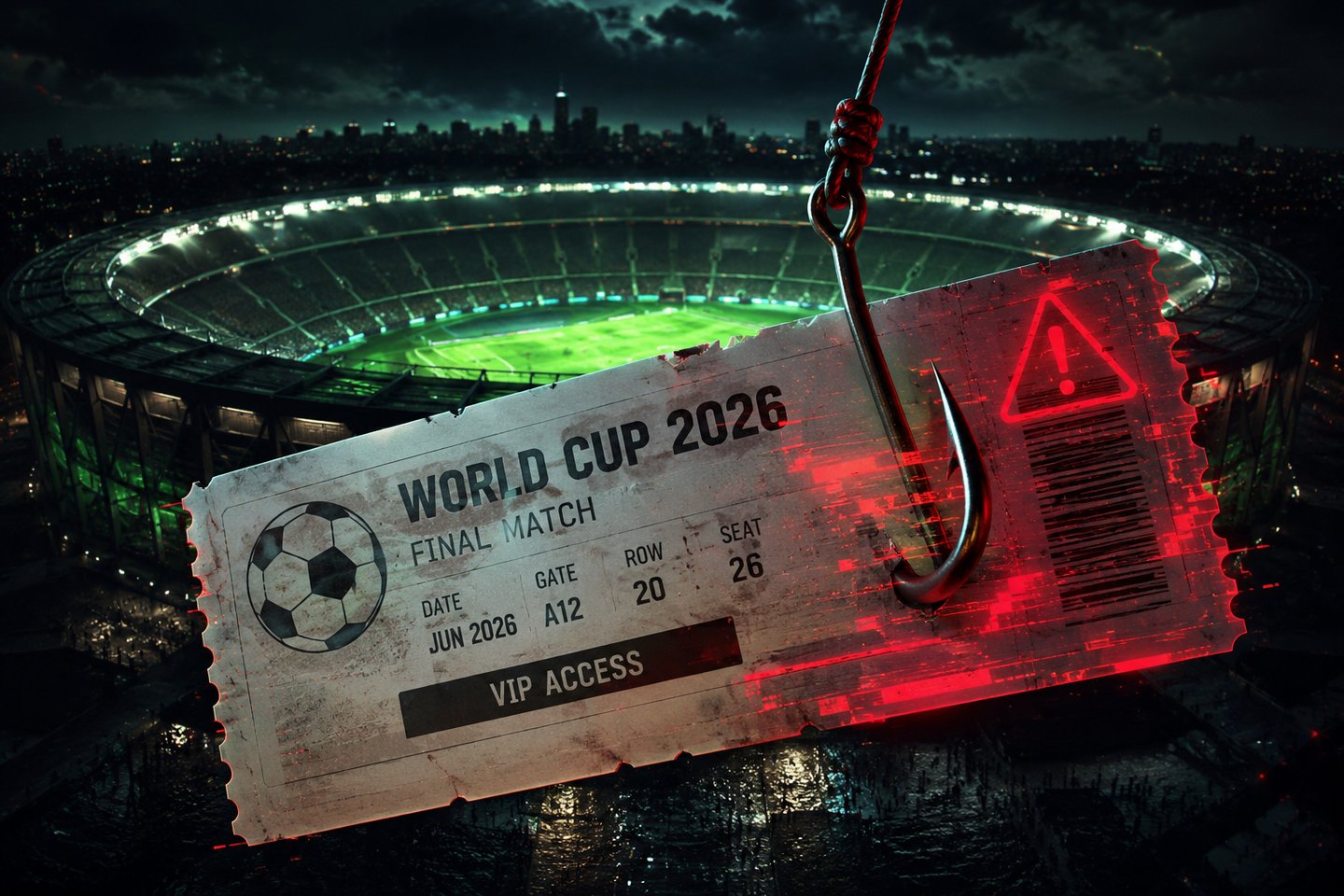
There's a particular kind of heartbreak that scammers are counting on this summer.
It's the dad who saved for months to take his kid to their first World Cup match. The group of friends planning a once-in-a-lifetime trip. The grandmother trying to surprise her grandson with tickets to see his favorite team. These are emotional, high-stakes purchases — and that emotion is exactly the vulnerability criminals are exploiting on a massive scale right now.
The 2026 FIFA World Cup is the biggest in history: 48 teams, 104 matches, 16 host cities across the United States, Canada, and Mexico, and an estimated global audience in the billions. It's also become the biggest scam opportunity in years. Security researchers have tracked over 13,000 World Cup-themed domains registered in just five months, and the FBI has issued a formal public warning naming dozens of fake FIFA sites designed to steal your money and personal information.
If you're planning to buy tickets, merchandise, or even just stream a match, this guide could save you from a painful and expensive mistake. Let me walk you through exactly how these scams work and how to shut them down.
Why This Tournament Is a Scammer's Dream
Major global events have always attracted fraud — the 2018 World Cup ran on fake ticket markets, and 2022 wrapped phishing around Qatar's fan ID system. But 2026 is different, for a few reasons.
First, the sheer scale. With 104 matches across three countries, there are simply more tickets, more travel, more merchandise, and more desperate last-minute buyers than ever before. More demand means more victims to target.
Second, sky-high prices. Official tickets are expensive and often sold out, which pushes fans toward resale markets and "deals" that look too good to pass up. Scammers live in exactly that gap between what fans can afford and what's officially available.
Third — and this is the big one — the scams have gotten frighteningly sophisticated. The crude, typo-ridden phishing pages of a decade ago are gone. Modern fake FIFA sites replicate the official visual design convincingly enough to pass a casual glance, and some are even powered by AI-generated content and deepfake celebrity endorsements.
This isn't a threat to dismiss. It's a well-funded, organized, and emotionally manipulative operation. The good news: once you know the patterns, the scams become surprisingly easy to spot.
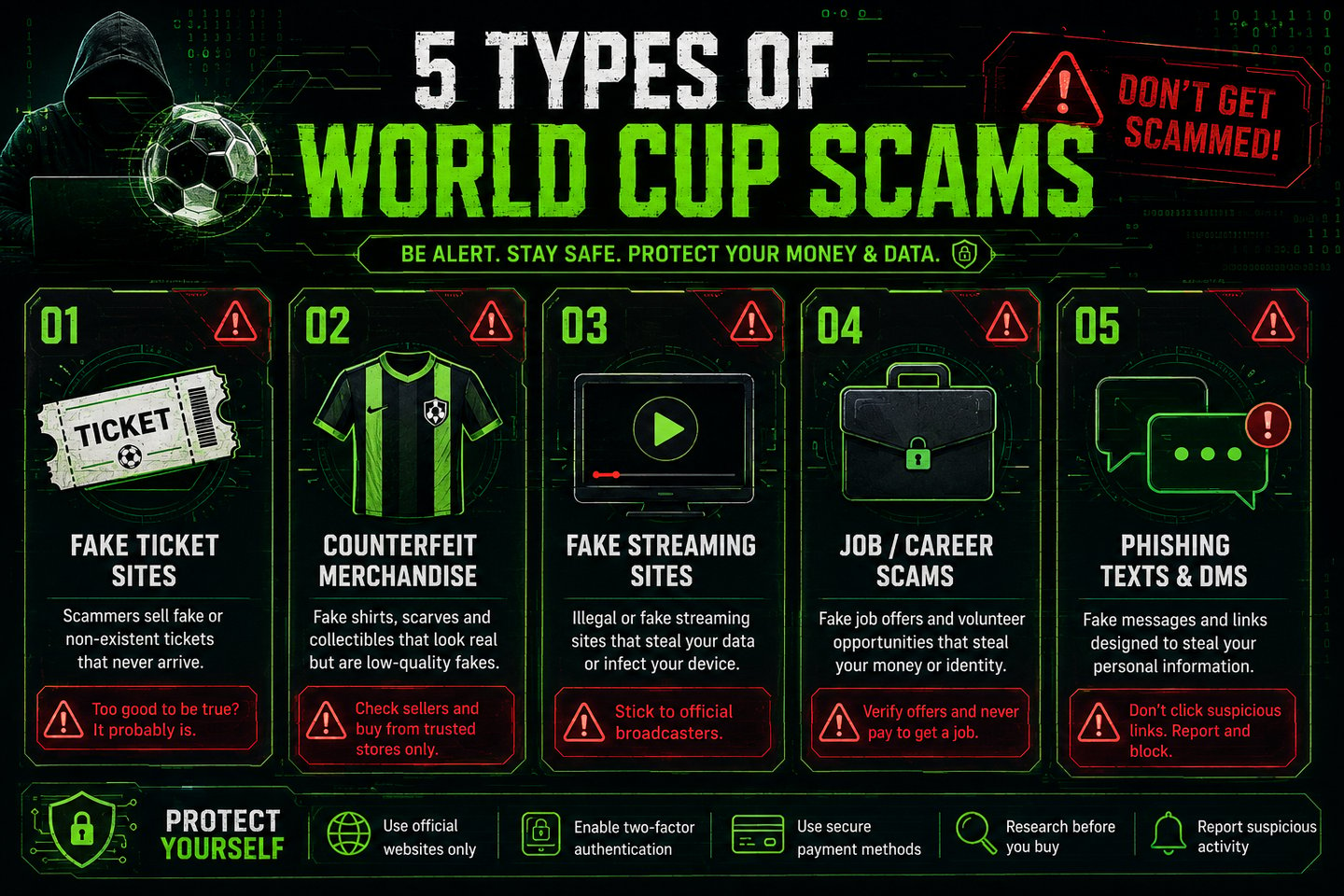
The 5 Main Scams to Watch For
Researchers and law enforcement have documented several distinct scam categories. Here's what each one looks like.
1. Fake ticket and hospitality sites. These are spoofed websites impersonating FIFA's official ticketing or hospitality portals. They advertise premium packages — tickets, lounge access, food and beverages — that simply don't exist. You pay, and either receive nothing or get a worthless fake. Worse, the personal and payment information you enter goes straight to criminals.
2. Counterfeit merchandise. Fake "official" jersey and gear shops flood social media ads. One documented scam ad showed a model wearing the wrong club's kit entirely — a dead giveaway to any real fan. You either receive cheap counterfeits or nothing at all, while your card details are harvested.
3. Fake streaming sites. Searching for "free World Cup stream" is dangerous territory right now. Malwarebytes identified more than 40 nearly identical websites promising free match streams that instead funnel visitors through chains of malicious ads — fake virus warnings, bogus software update prompts that install malware, and forced subscription traps.
4. Job and career scams. A separate fraud vector targets job seekers with fake "FIFA employment portals" advertising World Cup-related positions. These harvest your personal information — resume, ID details, sometimes payment for "processing fees" — under the guise of hiring.
5. Phishing texts, DMs, and emails. You may receive messages claiming to be from FIFA or official sponsors, often promising free tickets, gifts, or "unlocking" an offer. A group researchers nicknamed "Ghost Stadium" was found operating more than 300 phishing pages imitating the FIFA login screen, some loading visuals directly from official servers to look genuine.
How to Spot a Fake FIFA Site Instantly
Here's your most important defense. The FBI specifically warned about "typosquatting" — scammers using small spelling changes or odd web endings to trick people. Let me give you the concrete checks.
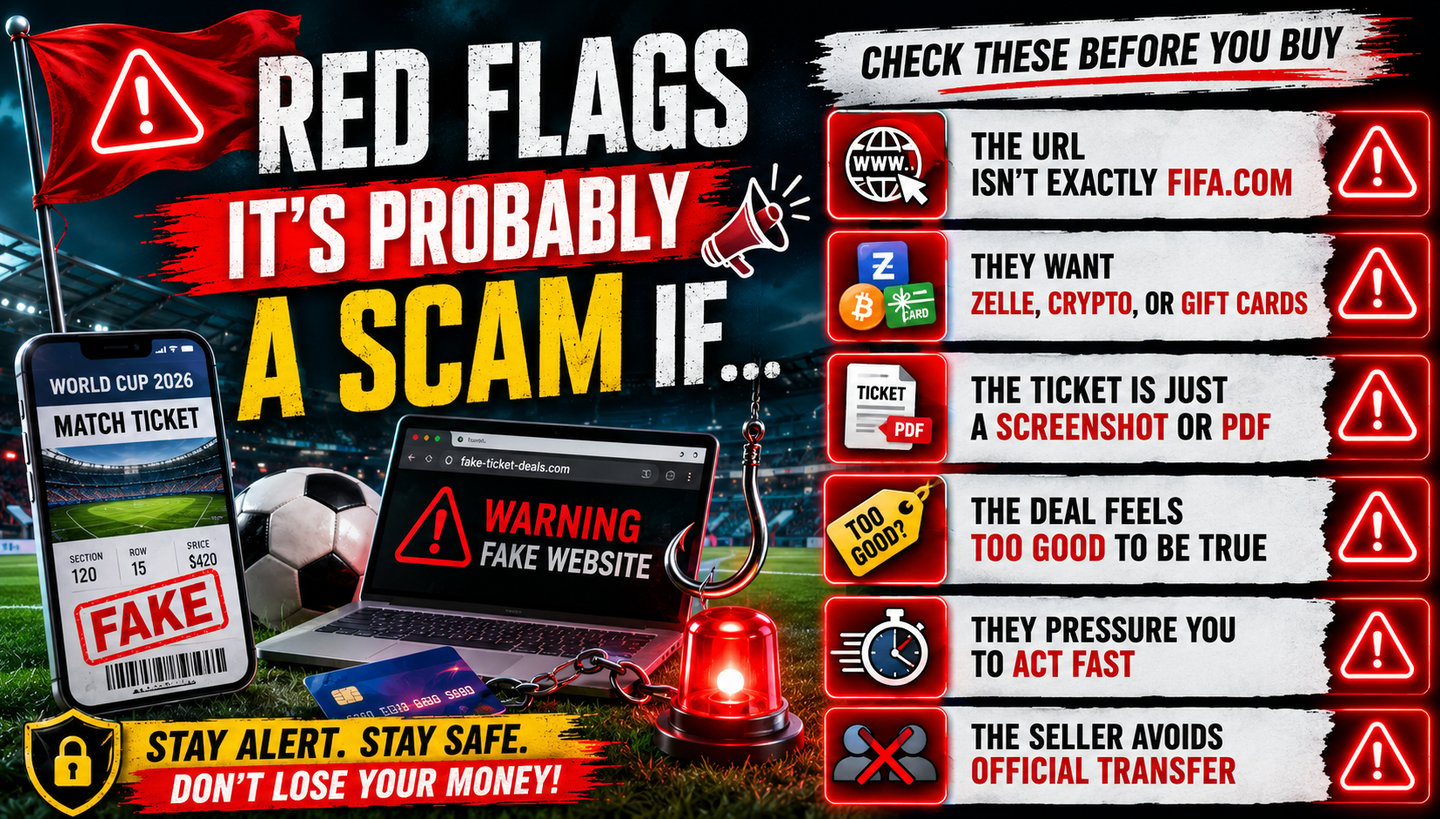
Look hard at the domain. The official FIFA website is exactly www.fifa.com. Scammers use variations: extra letters, strange endings, or added words like "ticket," "career," "hiring," or "worldcup." One documented trick changed "www" to "wvvw" — easy to miss at a glance. Before you type a single piece of personal information, stop and read the address bar carefully, letter by letter.
Type it yourself, never click. Don't reach FIFA's site through a link in an ad, text, email, or social media post. Type fifa.com directly into your browser. This single habit defeats the majority of these scams, because the fake sites depend entirely on you clicking their link rather than navigating directly.
Demand the official transfer process. A legitimate ticket transfers through the official ticketing system. A screenshot, a PDF, or a QR code image is not a real ticket. If a seller refuses to use the official transfer process, end the conversation immediately.
Watch the payment method. This is a huge red flag. Be extremely cautious if a seller asks for peer-to-peer payment apps (like Zelle, Venmo, or Cash App), cryptocurrency, gift cards, or a wire transfer. These payment methods offer little to no fraud protection and are nearly impossible to reverse. A credit card, by contrast, gives you stronger protections and the ability to dispute charges.
The Psychology: Why Smart People Still Fall for This
It's tempting to think "I'd never fall for that." But these scams don't succeed by fooling stupid people. They succeed by exploiting universal emotional triggers, and understanding them is part of your defense.
Urgency. "Only 3 tickets left!" "Sale ends in 10 minutes!" Scammers manufacture time pressure because rushed people skip the careful checks they'd normally make. When you feel that surge of "I have to act NOW," that feeling itself is the warning sign. Real opportunities rarely require split-second decisions.
Emotion. As one security analysis put it, this scam hits differently because the purchase feels deeply personal — a dream trip, a gift for your child, a memory your family will talk about for years. Scammers know an emotional buyer is a less critical buyer.
Scarcity and price. When official tickets are sold out or unaffordable, a "great deal" triggers relief and excitement that override suspicion. If a price is dramatically better than everywhere else, that's not luck — it's bait.
The defense against all three is the same: slow down. Almost every one of these scams relies on you moving fast. The simple act of pausing, closing the tab, and verifying through official channels defeats the entire playbook.
What to Do If You've Already Been Scammed
If you're reading this with a sinking feeling because you already paid — act quickly, and don't be ashamed. These operations are professional and designed to fool people.
Document everything immediately, before the site disappears. Save the fake domain, screenshots of your interactions, the information you provided, and all financial details — payment date, amount, account numbers, the receiving institution, or any cryptocurrency addresses. These scam sites often vanish quickly, so capture evidence now.
Contact your bank or card provider right away. If you paid by credit or debit card, call them, report the fraud, and ask about disputing the charge. The faster you act, the better your chances of recovery.
Report it to the authorities. File a complaint with the FBI's Internet Crime Complaint Center at IC3.gov. Include all the documentation above. Reporting promptly helps your case and contributes to getting these domains flagged and taken down faster, protecting others.
Change your passwords if you entered any login details. If the fake site captured a password you use elsewhere, change it on every account that shares it, and enable two-factor authentication.
Get free support. The AARP Fraud Watch Network Helpline offers free guidance from fraud specialists at 877-908-3360, Monday through Friday, and it's available to people of any age.
Stay Safe and Still Enjoy the Tournament
Let me end on the right note: none of this should stop you from enjoying one of the greatest sporting events on earth. The vast majority of fans will have an incredible time. You just need to be the informed one in your group.
Buy only through official channels and verified major resale platforms. Type web addresses directly. Pay with a credit card. Be skeptical of any deal that arrives in a text, DM, or social media ad. And trust that feeling in your gut — if something feels rushed, too cheap, or too good to be true, it almost certainly is.
Share this with the friends and family you're watching the matches with, especially anyone still hunting for last-minute tickets. The scammers are counting on people not knowing the patterns. Now you do — and that knowledge is the best protection there is.
Enjoy the games. Just keep your wallet, your passwords, and your personal information safely on your side of the field.
Frequently Asked Questions
What is the official FIFA website for World Cup 2026 tickets? The only official FIFA website is www.fifa.com. Always type this directly into your browser rather than clicking links from ads, texts, emails, or social media. Scammers create lookalike domains with small spelling changes or added words like "ticket" or "worldcup" to trick fans.
How can I tell if a World Cup ticket site is fake? Check the domain carefully against fifa.com — look for extra letters, odd endings, or added words. Be suspicious if the seller wants payment via Zelle, Venmo, crypto, or gift cards; if the "ticket" is just a screenshot or PDF; or if they refuse to use the official transfer system. Real tickets transfer through official ticketing platforms only.
Are free World Cup streaming sites safe? Generally no. Researchers found dozens of nearly identical fake streaming sites that don't actually stream matches but instead funnel visitors through malicious ads, fake virus warnings, and malware-installing prompts. Stick to official broadcasters and recognized streaming platforms.
What payment method is safest for buying tickets? A credit card offers the strongest fraud protection, since you can dispute charges and many cards include purchase protection. Avoid peer-to-peer apps (Zelle, Venmo, Cash App), cryptocurrency, gift cards, and wire transfers, as these are extremely difficult to reverse if you're scammed.
What should I do if I already paid a scam site? Document everything immediately (domain, screenshots, payment details), contact your bank or card provider to dispute the charge, report it to the FBI's IC3 at ic3.gov, and change any passwords you entered. You can also call the free AARP Fraud Watch Network Helpline at 877-908-3360 for guidance.
About the Author
Muhammad Ibraheem
Founder of Hackers Legacy | Cybersecurity Researcher & Privacy Analyst
Muhammad Ibraheem is a cybersecurity content creator with more than three years of experience producing educational content on ethical hacking, OSINT, privacy, and digital security. Through Hackers Legacy, he helps readers separate real cybersecurity threats from viral hype through research-driven analysis and educational content.
References & Further Reading
FBI IC3 — Public Service Announcement on FIFA World Cup Scams
Fox News — FBI Warns of Fake FIFA World Cup 2026 Ticket Sites
AARP — World Cup Ticket Scams Warning
Cyble — FIFA World Cup 2026 Scams Surge Analysis
Proton — How to Avoid World Cup 2026 Ticket Scams
Help Net Security — Fake World Cup Streaming Sites
Confiant — The 2026 FIFA World Cup Scam Landscape

HACKERS LEGACY

Your ultimate knowledge for Ethical Hacking, Cybersecurity insights, digital products and a global community of curious minds.
LEARN . HACK . LEAD
Quick Links
Resources
Contact Us
> Email Us
> Response Time
Within 24 Hours
> World Wide Access
We are available globally.
©2026 Hackers Legacy
All rights reserved.
Built for learners
Secured for the future.