How to Start Ethical Hacking in 2026 Using AI (Complete Beginner's Roadmap)
Learn how to start ethical hacking in 2026 using AI-powered tools and modern cybersecurity techniques. This beginner-friendly roadmap covers essential skills, learning paths, legal considerations, OSINT, networking, penetration testing, and the best AI tools for aspiring ethical hackers. Alternative Version:
ETHICAL HACKING
6/6/20269 min read


Let me tell you something the cybersecurity industry doesn't advertise loudly enough.
There are currently over 3.5 million unfilled cybersecurity jobs worldwide — and that number has been growing every single year since 2013. Companies are desperate. The gap between demand and supply is so wide that organizations are actively lowering their minimum requirements, funding training programs, and offering six-figure salaries to people who can demonstrate real skills — degree or no degree.
Ethical hacking sits right at the center of that gap.
And in 2026, something new has entered the picture: AI tools have made it faster than ever to learn, practice, and even assist in security testing. The question isn't whether AI changes cybersecurity — it does, dramatically. The question is whether you will be on the side using it to defend systems, or sitting on the sidelines watching others build careers from it.
This guide is your complete starting point. No fluff, no vague advice. Just the actual roadmap.
What Ethical Hacking Actually Is (And What It Isn't)
Before we talk about tools and certifications, let's be clear about what we're building toward.
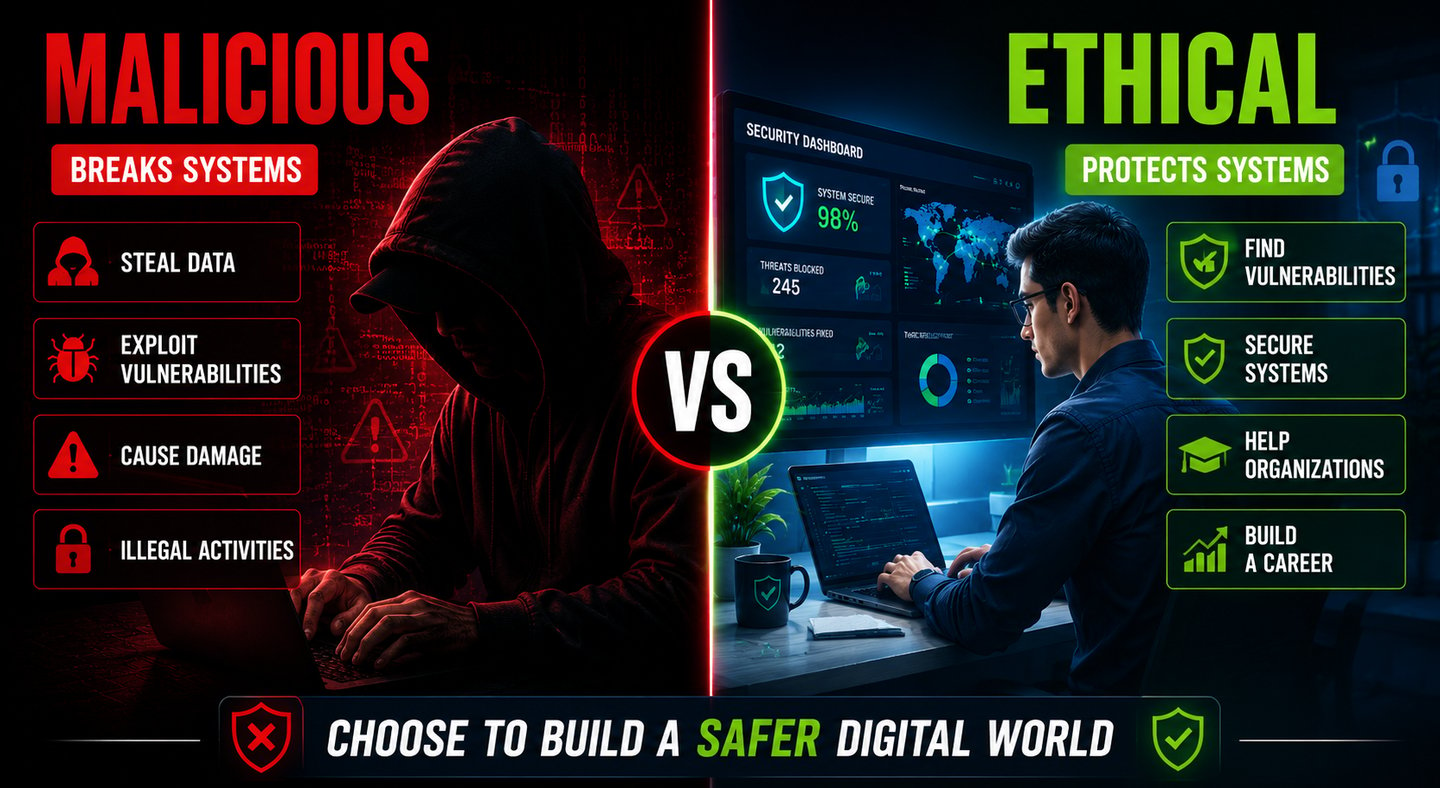
Ethical hacking — also called penetration testing or "pen testing" — is the authorized practice of probing computer systems, networks, and applications to find security vulnerabilities before malicious hackers do. The key word is authorized. An ethical hacker has written permission to test a system. Without that, it's just hacking — illegal in most countries under laws like the Computer Fraud and Abuse Act (CFAA) in the US and the Computer Misuse Act in the UK.
Think of it like this: banks hire people to try to physically break into their vaults to find weaknesses in security. Ethical hackers do the same thing digitally. Companies like Google, Meta, and Microsoft run bug bounty programs — paying independent researchers thousands of dollars for every vulnerability they responsibly report. HackerOne alone has paid out over $300 million in bounties to ethical hackers globally.
This is a real, well-paid, respected profession. Let's get you started.

The Foundation: What You Need to Learn First
Here is the honest truth that separates people who break into this field from people who spend years "preparing" and never actually apply anywhere: you do not need to know everything before you start practicing.
But you do need a working foundation in three areas.
Networking fundamentals come first. You need to understand how data actually moves across the internet — what TCP/IP means, how DNS resolves domain names, what a port does, and why firewalls work the way they do. This sounds intimidating until you realize it's just learning the grammar of a language you already use every day. The Professor Messer CompTIA Network+ Study Guide is completely free and one of the clearest explanations available — spend two weeks here before anything else.
Linux proficiency is non-negotiable. Almost every professional security tool runs on Linux, and Kali Linux is the industry-standard distribution built specifically for penetration testers. You don't need to be a Linux wizard, but you need to be comfortable navigating the terminal, managing files, running scripts, and understanding file permissions. OverTheWire's Bandit wargame is a brilliant, free, gamified way to build this — it teaches you Linux by making you hack into puzzle servers, which also makes it genuinely fun.
Basic programming or scripting is the third pillar. Python is the language of choice for cybersecurity — nearly every automation tool, exploit script, and security framework either uses Python or has Python bindings. You don't need to build applications from scratch. You need to read code, modify scripts, and understand what a function or loop is doing. Automate the Boring Stuff with Python by Al Sweigart is free online, practical, and directly applicable to security tasks.
These three foundations will take you roughly 60 to 90 days of consistent practice. Not years. Months.
Certifications That Actually Matter in 2026
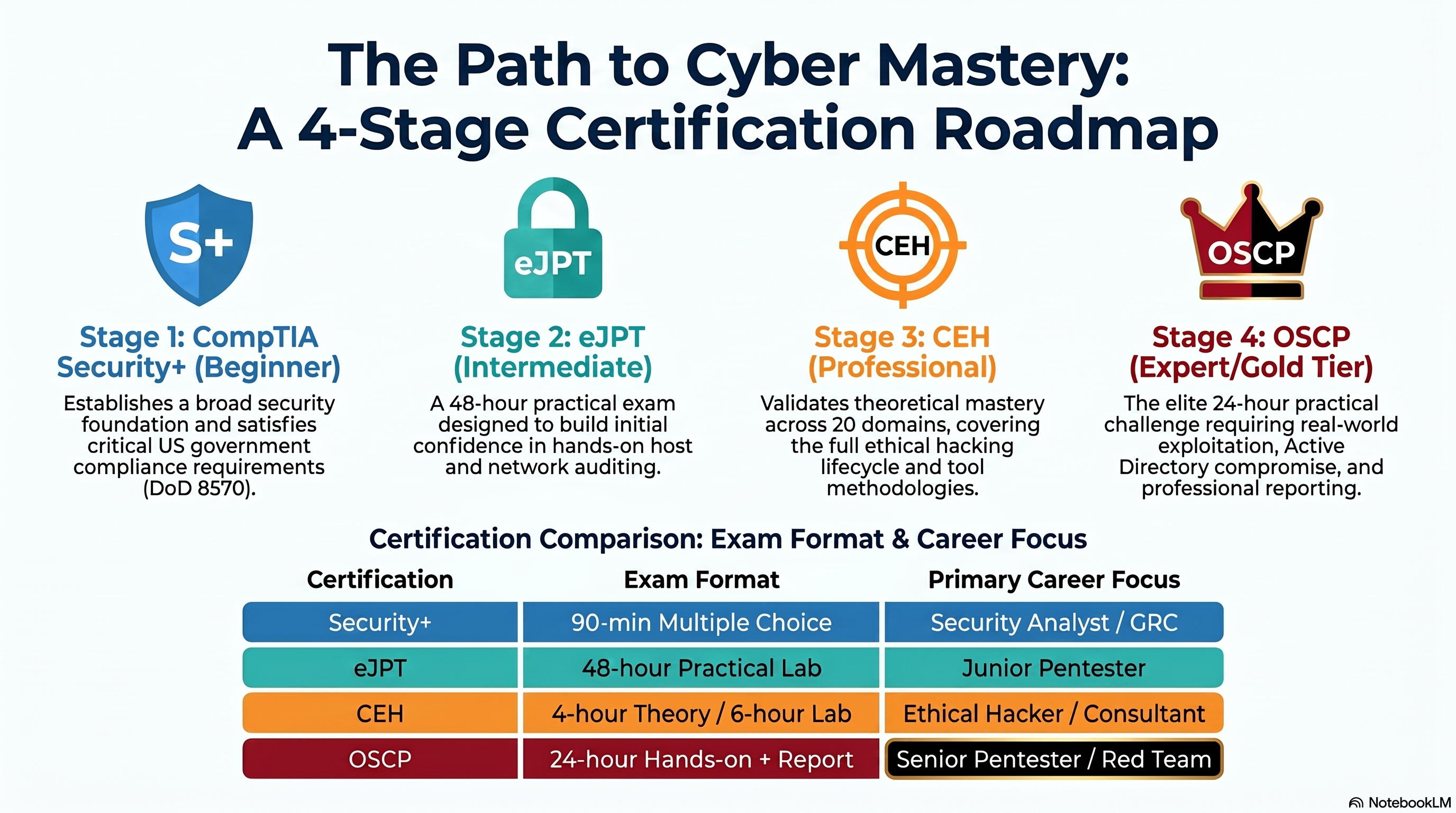
The cybersecurity certification landscape is crowded with expensive, low-value credentials. Here are the ones employers actually look for — in order of how you should pursue them.
CompTIA Security+ is the baseline. It's vendor-neutral, it's widely recognized, and many government and defense contractor positions require it. If you're completely new to the field, start here. It covers threat detection, risk management, cryptography, and identity management at a foundational level. Study time is typically 2–3 months.
eJPT (eLearnSecurity Junior Penetration Tester) is where things get interesting for aspiring ethical hackers specifically. Unlike Security+, which is multiple choice, the eJPT is a hands-on exam — you're given a real network to test and graded on what you find. eLearnSecurity offers this at a very accessible price point, and it's one of the most respected entry-level hands-on certs in the field.
CEH (Certified Ethical Hacker) from EC-Council is widely recognized in corporate environments, particularly in Asia and the Middle East. It has a mixed reputation among practitioners — some consider it too theoretical — but it opens doors in traditional enterprise hiring pipelines.
OSCP (Offensive Security Certified Professional) is the gold standard. If Security+ is your high school diploma, OSCP is your PhD. It's brutally difficult, 24-hour hands-on exam, and it will push you to your absolute limits. But having OSCP on your resume makes you immediately hireable anywhere in the world at senior rates. Work toward this after you have 1–2 years of practice under your belt.
Where to Practice Legally and Safely
This is the section most guides skip — and it's the most important one for beginners.
You must never practice on systems you don't own or don't have written permission to test. Not on your neighbor's WiFi. Not on a company's website "just to see." Not on anything you don't explicitly control or have a signed scope agreement for. This is not a gray area. Unauthorized access is a criminal offense in virtually every jurisdiction.
The good news is there are excellent, completely legal environments built specifically for practice.
TryHackMe is arguably the best starting point on the internet for beginners. It provides browser-based virtual machines, guided learning paths, and hands-on rooms that walk you through concepts step by step. You don't need to install anything. Their "Pre-Security" and "Jr Penetration Tester" paths are exceptionally well-structured, and the free tier gives you access to a substantial amount of content.
Hack The Box is the next level — less hand-holding, more real-world challenge. Their machines are retired after a period and write-ups become available, so you can always check your approach against expert solutions. The community is active, knowledgeable, and welcoming to beginners who show effort.
PentesterLab focuses specifically on web application security, which is one of the most in-demand specializations. Their exercises are built around real vulnerability classes — SQL injection, cross-site scripting, authentication bypasses — using purposely vulnerable web apps in a safe environment.
Build a habit of spending at least one hour per day on these platforms. Consistency beats intensity every single time in skill development.
How AI Is Changing Ethical Hacking in 2026
This is where the 2026 landscape gets genuinely exciting — and where having AI fluency gives you a serious edge over people who trained even two years ago.
AI as a learning accelerator is the most immediate benefit. Tools like Claude can explain a confusing networking concept in five different ways until one clicks, walk you through what a piece of unfamiliar code does line by line, or quiz you on penetration testing methodology before an exam. What used to require expensive tutors or slow forum threads can now happen in a conversation.
AI-assisted reconnaissance has become a real workflow in professional pen testing. AI tools can help you rapidly analyze large amounts of publicly available information about a target organization — open-source intelligence (OSINT) — to map attack surfaces faster. Tools like Shodan, which indexes internet-connected devices, now pair with AI-powered analysis layers to surface meaningful patterns in data that would take days to manually review.
AI for code review and vulnerability scanning is transforming how security teams work. GitHub Copilot and similar tools are being used by both developers and security researchers — developers to write code faster, and security researchers to quickly audit that code for common vulnerability patterns. Understanding how to prompt these tools effectively for security tasks is a new skill with immediate professional value.
AI-powered CTF (Capture The Flag) assistance is also changing how people learn. When you're stuck on a challenge at 2am, an AI assistant that can discuss your approach, suggest different angles, and explain the underlying concept without just giving you the answer is an extraordinary learning tool. Use it to understand, not to bypass the learning.
One important caveat: AI tools also make attacks easier to automate, which is why the demand for ethical hackers who can anticipate AI-assisted attacks is rising just as fast. Learning to think offensively about AI-powered threats — prompt injection in AI systems, automated vulnerability exploitation, deepfake-based social engineering — is becoming its own specialization. OWASP's AI Security Top 10 is required reading if you want to get ahead of this curve.


Building Your First Bug Bounty Portfolio
Theory without proof is worth nothing in this industry. What gets you hired — or gets you paid through bug bounty — is a public record of what you've actually found and responsibly disclosed.
Start by setting up a simple blog or GitHub profile where you document your learning journey. Write walkthroughs of TryHackMe or Hack The Box machines after you complete them. Explain what you tried, what failed, what worked, and what you learned. This serves two purposes: it reinforces your own understanding (teaching is the best test of knowledge), and it demonstrates to potential employers that you communicate clearly — a massively underrated skill in security.
When you feel ready for bug bounty, start with programs that explicitly welcome beginners. HackerOne's public programs and Bugcrowd's bug bounty programs both list hundreds of scopes, and some specifically mark themselves as "good for beginners." Read the scope documents carefully — they define exactly what you're allowed to test and what is out of scope.
Your first bug may take months to find. That is completely normal. Many successful bug bounty hunters submitted 50 or 100 reports before their first valid finding. The skill builds underneath each attempt, even the unsuccessful ones.
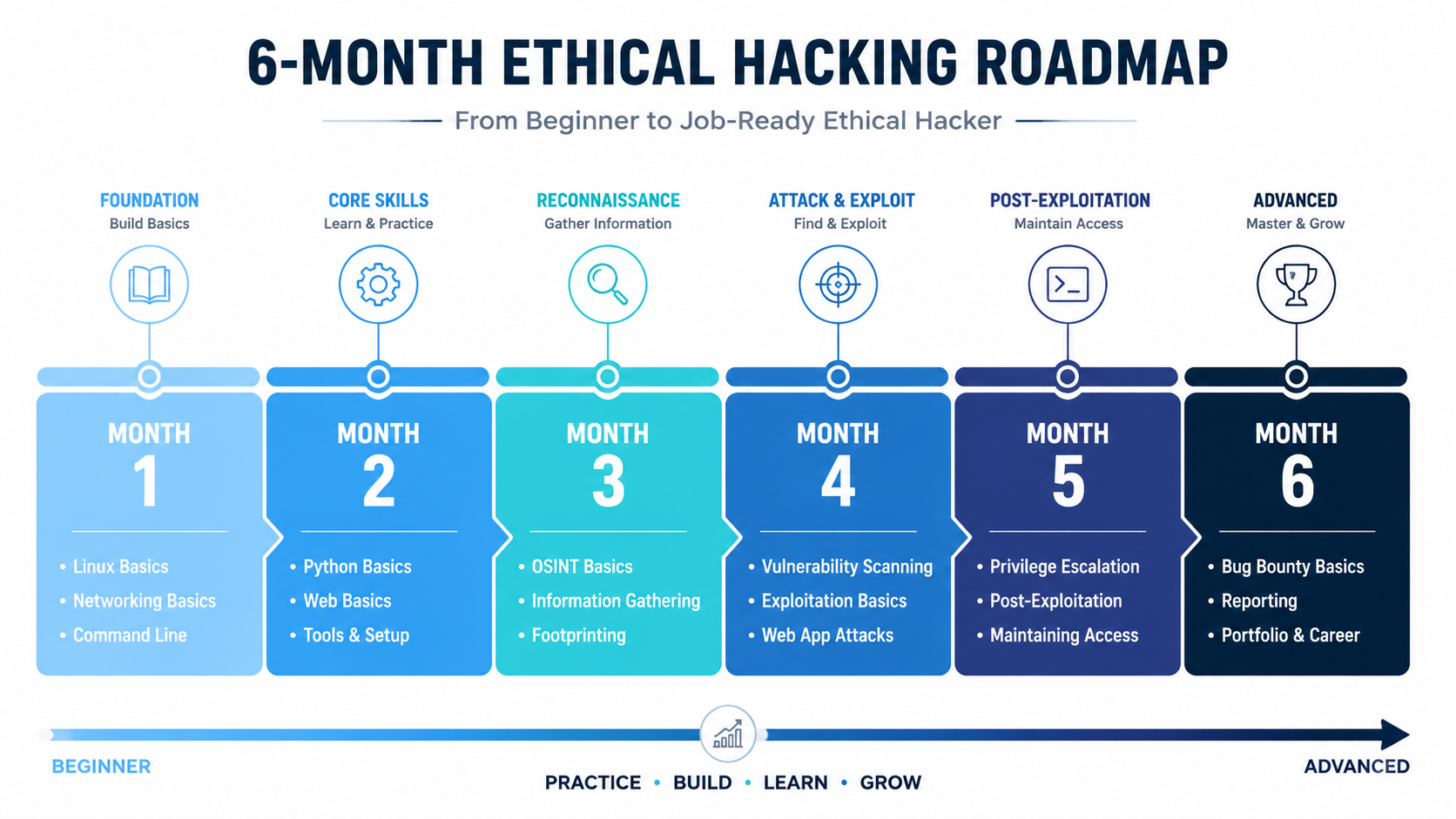
A Realistic 6-Month Roadmap
Rather than leaving you with a general sense of direction, here is what a focused six months actually looks like.
In months one and two, complete the Professor Messer Network+ content, finish the OverTheWire Bandit wargame through level 20, and start TryHackMe's Pre-Security learning path. Set a daily timer for 90 minutes and protect it like a meeting you can't cancel.
In months three and four, begin TryHackMe's Jr Penetration Tester path, start learning Python through Automate the Boring Stuff, and study for your CompTIA Security+ exam. Take practice exams until you're consistently scoring above 85% before booking the real one.
In months five and six, move to Hack The Box, begin your eJPT preparation through eLearnSecurity's course material, start a blog documenting your HTB write-ups, and register on HackerOne to read through beginner-friendly bug bounty scopes — even before you submit anything. Familiarity with real programs changes how you think while practicing.
At the six-month mark, you will not be an expert. But you will have more practical, demonstrable skill than a large percentage of candidates applying for entry-level security analyst roles — which is a genuinely good position to be in.
Final Thought: The Mindset That Actually Gets You There
Every successful security professional I've spoken to says the same thing in different words: the skill of ethical hacking is mostly the skill of stubborn curiosity.
The technical knowledge is learnable. The tools change every year anyway — what stays constant is the habit of asking "why does this work this way?" and "what happens if I try this instead?" That mindset, applied consistently, turns confused beginners into confident professionals.
The 3.5 million job openings aren't waiting for people with perfect backgrounds. They're waiting for people who care enough to go find the answers.
You already took the first step by reading this far.
Frequently Asked Questions
Can I learn ethical hacking without a computer science degree? Absolutely. Many of the best penetration testers are self-taught or came from unrelated fields. What matters is demonstrable skill — certifications and a portfolio of practice work carry far more weight than a degree in this field.
Is ethical hacking legal? Ethical hacking is completely legal when you have written authorization to test a system. Bug bounty programs provide that authorization explicitly. Testing any system without permission — regardless of your intent — is illegal in most jurisdictions.
How long does it take to get a job in ethical hacking? With consistent daily practice and the roadmap above, most dedicated beginners are job-ready within 12 to 18 months. Accelerated learners with prior IT experience sometimes achieve this in 6 to 9 months.
What's the average salary for an ethical hacker in 2026? According to Glassdoor's cybersecurity salary data, entry-level penetration testers earn between $70,000 and $95,000 annually in the US, with mid-level professionals averaging $110,000 to $140,000. OSCP-certified professionals and specialized consultants often earn significantly more.
Do I need my own lab setup? Not initially. TryHackMe and Hack The Box run entirely in the browser. When you're ready to go deeper, a basic lab with VirtualBox running Kali Linux on your existing computer is enough to start — no expensive hardware needed.
Found this guide useful? Share it with someone who's thinking about getting into cybersecurity — the industry needs more good people.
References & Further Reading

HACKERS LEGACY
Your ultimate knowledge for Ethical Hacking, Cybersecurity insights, digital products and a global community of curious minds.
LEARN . HACK . LEAD
Quick Links
Resources
Contact Us
> Email Us
> Response Time
Within 24 Hours
> World Wide Access
We are available globally.
©2026 Hackers Legacy
All rights reserved.
Built for learners
Secured for the future.